Going Aloft at Sea
Safety counts when leaving the deck
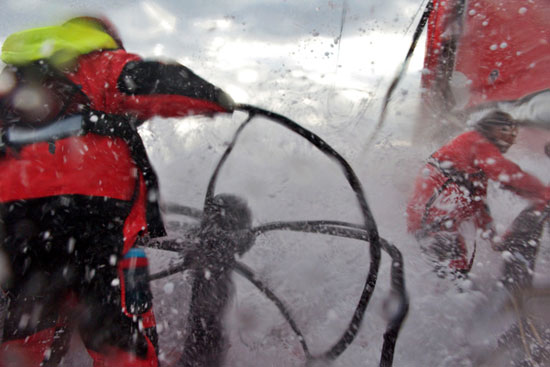
 Once, while blasting through the Southern Ocean aboard Alaska Eagle in the Whitbread race, I looked behind me to see a massive squall approaching. I was at the top of the mast unwrapping a wrapped halyard. Moments later the squall hit, and for a few minutes it snowed so hard that I could not see the boat below. I could see my feet, and the top spreader. Below that, only white horizontal snow. I could hear the water rushing by as the boat surfed, and prayed that the helmsman would keep a steady course. The squall passed by, I unwrapped the halyard, and descended to the relative safety of the deck. It was just another day at the office.
When I sailed a later Whitbread aboard Drum, we would sometimes hoist ourselves onto the head of the spinnaker and lay there in the world's largest hammock looking up at the sky. We were 115 feet off the water, cradled in a bed of nylon. It was dangerous and foolish, but so much fun. They don't do that kind of thing anymore because the racing is too intense for frivolity, but when you are young with an IQ less than the length of the boat, fear is not a factor. As they say, it seemed like a good idea at the time.
I am older now, and where I once looked forward to going aloft, I now dread the thought. I dread it even more when I have to do it alone at sea. This is a healthy attitude to have. Leaving the deck can be dangerous, and your approach needs to be well thought out well in advance. Despite your fervent wishes to the contrary, one day you will have to climb the mast, and with that in mind, you might as well learn how to do it right.
Dress and Prep
Clothing: First of all, dress for success. Be sure to be wearing good snug shoes and tight-fitting clothing, and pack your bag with all the tools you might need for the trip. Gloves are optional. Sod's Law applies. If there is a loose piece of clothing flapping in the breeze, it will catch on something, and it will catch at the worst possible moment. I like to wear fleece tights. They provide a friction-free ride and save my legs from split-pin snags.
 I wear them even if it's hot. When I am nervous I sweat, and when I sweat my legs stick to the mast. It's better to be hot and friction-free, than cool and stuck to the paint. I close my eyes and visualize precisely what I need to accomplish the job. Then I make a mental to-do list. The tools are tossed in the bag, and the bag is slung over my shoulder where it's out of the way. Dressed and prepped, it's time to ponder the perfect procedure for going aloft.
Rule No. 1: Unless you have no alternative, always go aloft on a halyard that runs down the inside of the mast. By making this choice, you eliminate the potential for a major disaster. If the sheave breaks, you will only drop a few inches until the halyard snugs up on the exit box.
Rule No. 2: Don't worry about the strength of the halyard. Unless it has been baking in the sun for years, or is chafed and frayed and in dire need of replacement, it will be strong enough to hold you.
 Rule No. 3: Always tie the end of the halyard onto your bo'sun's chair. Do not rely on snap-shackles, regular shackles, or any other kind of attachment. Nothing is more trustworthy than a well-tied knot - preferably a bowline and a half-hitch, which is not only secure, but easy to untie after its been under extreme load and, if improperly tied, will look very wrong and, thus, can be detected early.
Rule No. 4: If possible, settle the motion of the yacht as much as you can. If you have sea room, run off until the angle of the wind and waves steadies the motion of the boat. You are now ready for liftoff.
Leaving the Deck
The cast: There's you, of course, or whomever has been appointed to this elevating detail. Then there's the person winding the winch. Your 30-foot lugger may not come with a muscular professional sailor ready and willing to hoist you up the rig. For those lucky enough to have one on board, remember that your life is squarely in his or her hands, so choose your help with the same care as you would choose your doctor. A bad choice might result in a visit to the latter.
And a spotter is nice. If two muscular professional sailors are on board, recruit them both. It's useful to the grinder, whose range of vision is seriously compromised by his position at the winch, to have a spotter report your progress to him as you approach, say, spreaders or the masthead. Additionally, a spotter can provide a quick backup in the event the winder gets attacked by a wayward wasp and tosses the tail in the air.
The route: Choosing your route for going aloft has as much to do with personal preference as it does sea conditions. Some like to be hoisted up the leeward shrouds, while others prefer the solid security of the mast. I prefer to have the genoa halyard flicked around the shrouds, and ascend up the backside of the mast on the windward side of the mainsail. It adds friction, but there is less to snag on, and the sail provides a small sense of security. If you have an adequate topping-lift, use it for ascending. Or if you are running off, consider dropping the mainsail and using its halyard. If the boat is bobbing through slop and chop, a trip up the leeward shrouds is not recommended; however, if the water is smooth and the yacht gently heeled, it's a quick snag-free route to the top.
A downhaul: Either way, be sure to have a strong downhaul line attached to the bottom of your bo'sun's chair and secure in the hands of a watchful crewmember. The downhaul will stop you from swinging around, and it can keep you out and away from your handholds. In long-past days of J Boat sailing, the downhaul was there to stop the crewman from getting propelled into thin air as the weight of the halyard in the mast, exceeded the weight of the crewman going up the mast. Small guys like me think of these things.
Aloft Shorthanded
All of the above is fine if your boat comes standard with modern blocks, adequate winch power, and the aforementioned muscular professional sailor. If not, you are presented with a different set of circumstances requiring different solutions.
Hoister or hoistee?: A couple on a well-appointed yacht should split the duty into the hoister and hoistee — and it is not always the man who has to go aloft. Many women have better stomachs for heights than men, and are more nimble.
The windlass: Run the halyard through a set of snatch blocks to the windlass, and use the ship's power for hoisting. The same rules apply, but be careful; the windlass is a powerful machine and could do some damage to the hoistee if you are not careful. If there is no windlass, then I'm afraid the lighter person draws the short straw and gets winched aloft by the heavier person. It's long, slow and tiring, but it gets the job done.
Mechanical advantage: However, a few things can be done to make the job easier. A simple 2:1 purchase added to the halyard effectively halves your weight, or doubles the power of the winder. An extra-long (twice your mast height plus some) spinnaker sheet, doubling specifically for this purpose, can be run through two blocks to form the purchase. One block is attached to the halyard and hoisted to the masthead, while the other is secured at the base of the mast, with the tail led aft to a winch in the cockpit. The line deadends on your bo'sun's chair. Your trip aloft will take twice as long, but this rig will save the winder from needing a dose of steroids.
Going Solo
If you are alone, or without sufficient manpower for the job, you can still make it to the top — providing you have planned ahead for the possibility. There are two ways to accomplish this. Neither of them are any fun, and both are fraught with potential problems. Pick your poison.
Jumars: For the first you will need a 4:1 purchase, a jumar, and a lot of resolve.

The double-jumar, foot-loop method works well for the solo sailor.
A jumar is a simple, one-way rope clamp that mountain climbers use for hoisting themselves up rock faces. Fasten one end of the purchase to the halyard, the other to the bo'sun's chair, and then hoist the halyard to the top of the mast. You are now required to pull yourself up the mast taking comfort from the fact that you have a 4:1 purchase, and strong arms. You can make the trip a little easier by adding a ratchet block at the top of the mast. The ratchet allows you to ascend friction-free, while adding friction for your descent. It also allows you to change hands to pull without your full weight on the tackle.
Don't rely on a cleat to hold you while you change hands, unless your insurance policies are all in order. This is where the jumar comes in. Attach the jumar to your chair with a short length of webbing, and clamp it over the hoisting line. Use one hand to steady the line, and the other to slide the jumar. The jumar acts as your cleat as you hoist yourself up the mast. With the jumar attached to your bo'sun's chair, you are able to rest as often as you want, and still have both hands free for doing other things — like holding on.
Third hand: This method works fine at the dock, or if the sea is calm, but since it requires two hands for hoisting, it leaves none for hanging on. You can remedy this somewhat by taking a spare halyard, if you have one, attaching it to the base of the mast, and winding it bar-tight. Fasten a snap shackle to your chair, and clip it around the spare halyard. If your halyard is tight enough, it will stop you from swinging away from the mast while you use your hands for hoisting. With some grunt and determination, you will make it to the top.
Mast steps: Have a short strop attached to your chair and use it to clip yourself to a fixed point at the masthead. Some skippers have even added steps right at the masthead to facilitate working aloft. They are windage and one more thing for halyards to catch on, but very useful when you need them.
Getting down: It's easy unless Sod and his law foil you. Your 4:1 tackle leaves a lot of tail dangling in the wind, and if luck is not on your side, or if the stars are misaligned, the tail could snag on a deck fitting. Your only option, other than fervent prayer and wishful thinking, is to climb out of the chair and shimmy down the mast. Not a pleasant thought. Your odds are increased if you flick the tail overboard, and let it drag in the water behind the boat, but there are no guarantees. As I said, it takes a strong resolve, a bit of luck — and sailor-friendly gods.
Brian's Way
So how do I go aloft when I am alone? It's not a simple process, but it has worked well and I am still here to write about it. I use three variations on the jumar method. I also use a climbing harness in favor of a bo'sun's chair, and in anticipation of having to go aloft alone, I had webbing steps sewn up the luff of my mainsail. You might have steps permanently fitted to you mast and would use these instead of the webbing steps.
 I always climb up the after side of the mast, on the windward side of the sail, clipping ontoa spare halyard. The halyard is flicked around the spreaders, secured at the base of the mast, and wound tight. If the conditions are moderate, I use the webbing steps to go aloft. I step into the lower loops, and pull myself up, using the upper loops. I clip myself to a single jumar that runs up the spare halyard. The jumar is there to arrest my fall should I slip or get bounced off the sail. It's actually quite easy to climb up the mainsail if the boat is heeled over. The only difficulty is bringing the jumar along, but it's my safety net and important.
If the boat is more upright, or if the conditions are bumpy and I am feeling safety-conscious, I use my double-jumar, foot-loop method. There are two variations to this, and it depends upon the number of spare halyards I have available. On a good day, I have two spare halyards, and flick them both around the windward spreaders and clip them to the base of the mast. Each jumar has a length of webbing attached to it which terminates in a loop. I hook a jumar onto each halyard, and place my feet in each of the loops. My harness is attached to both jumars.
By placing my weight on the upper jumar, I am able to slide the lower jumar up the halyard. I then transfer my weight and repeat the process. In this way I am able to slowly shuffle my way up the mast. The key to this is how tight I am able to wind the halyards. If they are sloppy, you will bounce around and climbing will not be easy. Bar-tight, and it's a two-step jig up the rig.
The two-step jumar jig becomes more complicated if you have only a single spare halyard available. You have to attach both jumars onto the same halyard, and shuffle your way aloft by moving the lower jumar to just below the upper one, and then sliding the higher one higher.
A quick word about the trip down. If you are lucky enough to have a helper to winch or windlass you up, that person will be the one to let you down. Make it a smooth trip for the passenger. They have had a hard enough time aloft. Remove some of the turns from the winch placing one hand over the remaining wraps to secure them. Take the tail in the other hand, pay out an arms length, and then smoothly lower the person without jerking them. It's no fun — and it's dangerous — to be jerked around.
Whichever method you use for going aloft, leaving the safety of the deck is a leap in faith. The potential for problems multiplies the higher we go. The vagaries of weather and hazards of shipping and other unexpected obstacles make the trip more difficult, especially if you are alone. I have an extension attached to my remote auto-pilot control, and can alter course from as high as the first spreaders. Above that, I am again at the mercy of Old Sod.
There has been more than one occasion where I have shuffled my way to the second spreaders, only to see a squall rolling in, or a ship on a constant bearing, and had to double-time-shuffle back down again. Going aloft is something that should not be avoided if there is a matter to tend to. Instead it should be approached with firm determination, a quick check of things to bring, and a glance at the horizon for ships. Plan ahead, take it slowly, anticipate the worst, and be thankful when it's over.